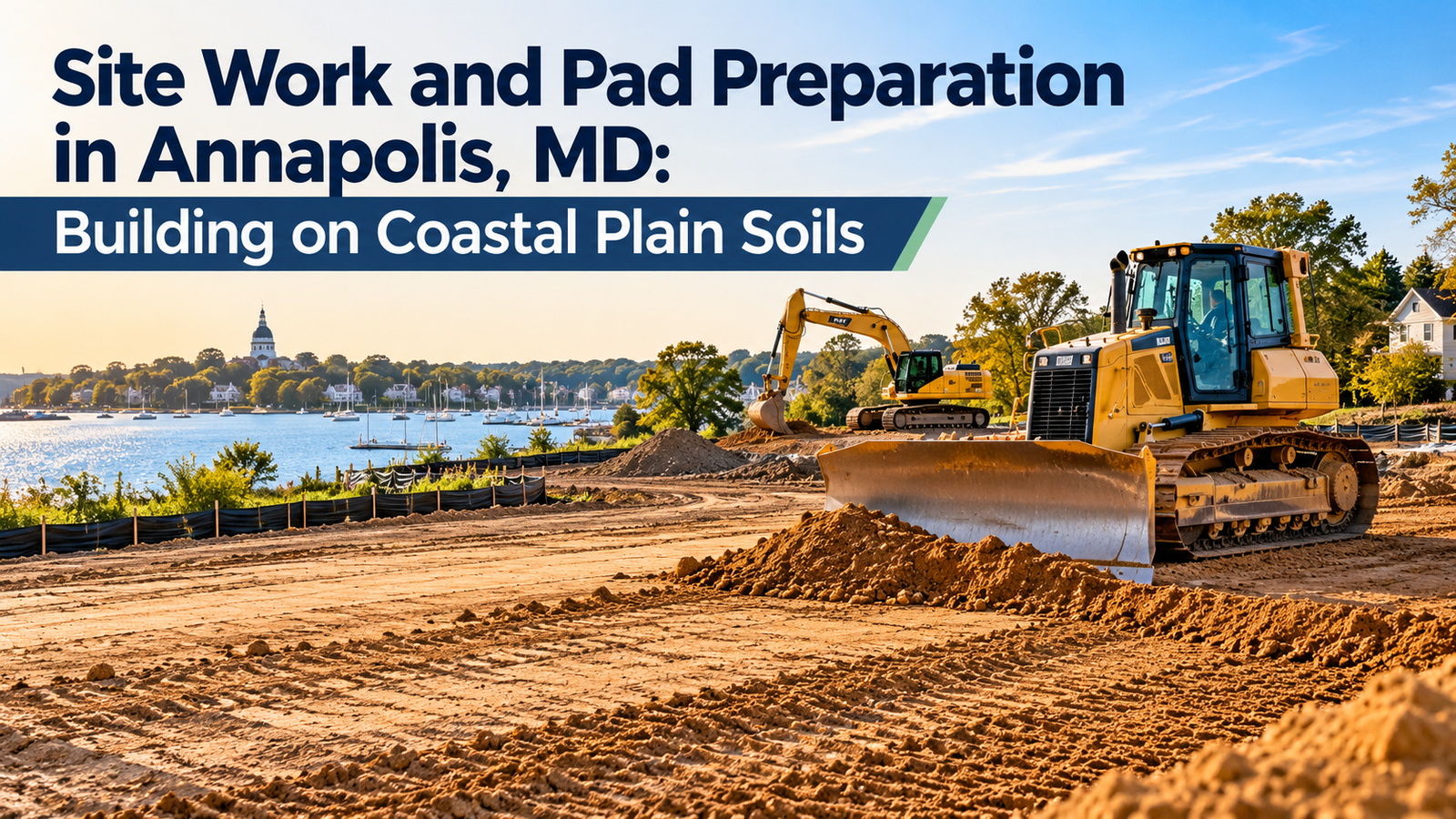
Site work and pad preparation in Annapolis involve engineering challenges specific to the Coastal Plain setting, the tidal waterfront environment, and the strict environmental regulations that govern construction in the Chesapeake Bay watershed. Before any structure can be built in the Annapolis area, the site must be prepared to support it and in this part of Maryland, that preparation process is shaped by soils that behave differently from the rocky uplands of western Maryland or the firm piedmont soils of the central part of the state.
What Site Work and Pad Preparation Involve
Site work pad preparation Annapolis encompasses the full range of earthwork operations that prepare a parcel for construction: clearing and grubbing, stripping topsoil, mass grading to establish design grades, subgrade preparation, underground utility installation, and stormwater infrastructure construction. Pad preparation is the final phase the precise preparation of the building footprint area to the elevation, slope, and bearing capacity specified by the structural engineer.
In Annapolis, these operations are complicated by the coastal setting. Mass grading must account for Coastal Plain soils with variable compressibility. Underground utility installation encounters shallow groundwater. Stormwater infrastructure must meet Critical Area and Bay watershed standards. The sequence and method of each operation must be planned with these local conditions in mind, not adapted from standard practices developed for different geological settings.
Topsoil and Organic Material Management
The first step in site preparation is stripping and stockpiling topsoil separately from subsoil. Annapolis’s upland soils typically have 6 to 10 inches of organic A-horizon topsoil, while low-lying areas near the waterfront may have thicker organic deposits sometimes a foot or more of fibrous or mucky material near former marsh areas. All organic material must be removed from areas that will support structures or pavement because organics compress and decompose under load, causing settlement.
Organic material that cannot be used as topsoil elsewhere on the site must be disposed of off-site. Near-waterfront areas with high organic content may have material that requires testing before disposal, as it could contain contaminants from historic water quality conditions. This is a consideration specific to Annapolis’s waterfront properties that is less relevant for inland sites.
Topsoil stockpiles must be managed for erosion control throughout the construction period. Uncovered topsoil piles are a significant source of sediment runoff, particularly in Annapolis’s rainy climate. Covering stockpiles with temporary seeding or filter fabric prevents topsoil loss that would otherwise require imported replacement at project close-out.
Subgrade Assessment and Preparation
After topsoil is stripped, the subgrade the native soil that will support the aggregate base and structure above must be assessed and prepared. In Annapolis’s Coastal Plain setting, subgrade assessment is more variable than in areas with more uniform geology. The same parcel may have sandy upland soil in one portion and soft, silty material near a former drainage channel or low spot.
Proofrolling driving a loaded vehicle over the prepared subgrade to detect soft spots through visible deflection is a rapid field method for identifying areas that need additional attention. Soft or unstable areas detected by proofrolling must be over-excavated and replaced with engineered fill, or stabilized with lime or cement, before aggregate base is placed.
In areas where the native subgrade is consistently weak as in low-lying areas with clayey or organic soils subgrade stabilization may be required across the entire building footprint. Lime stabilization of clay subgrades is effective in Anne Arundel County’s clay-bearing soils: lime reacts with the clay minerals to reduce plasticity and increase strength, creating a more stable platform for subsequent base and slab construction.
Where organic soils are too deep or too soft to stabilize, over-excavation and replacement with select fill may be required to reach a competent bearing layer. The depth and extent of over-excavation is determined through geotechnical investigation soil borings that characterize the stratigraphy and identify bearing layers. For structures with significant loads, deep foundations that bypass soft near-surface material entirely may be the most practical solution.
Aggregate Base Placement and Compaction
The aggregate base course crushed stone placed between the subgrade and the concrete slab or pavement distributes structural loads and provides drainage. In Annapolis’s setting, where groundwater is often shallow and rainfall frequent, the drainage function of the base is particularly important. Open-graded aggregate base, which drains freely rather than holding water in fine-particle voids, is preferred for building pad applications where moisture management is critical.
Base course material used in the Annapolis area is typically Maryland SHA (State Highway Administration) No. 2 or No. 57 crushed stone from quarries in the region. Crushed stone is preferable to processed gravel for base applications because its angular particles interlock under compaction, creating a more stable base than rounded particles.
Compaction of the base course is verified through density testing nuclear density gauge measurements or sand cone tests that confirm each lift has achieved the required relative compaction. Maryland’s construction standards, followed by most contractors in the Annapolis area, require 95 to 100 percent of maximum dry density (per ASTM D698 or D1557, depending on application) for base courses beneath structural slabs.
Stormwater Infrastructure as Part of Site Work
In Annapolis’s regulated environment, stormwater management facilities are not an afterthought they are integrated into the site work from the beginning of the project. New development above specified thresholds must manage stormwater to comply with Maryland’s stormwater management regulations and Annapolis’s Critical Area requirements.
Common stormwater management approaches in the Annapolis area include bioretention cells (rain gardens) that capture and infiltrate runoff, wet ponds that provide detention and water quality treatment, and rooftop or pavement disconnection that routes runoff to vegetated areas before it enters the storm drain system. These facilities must be constructed during the site work phase before buildings are erected so they can function during the construction period to capture sediment-laden runoff.
Annapolis’s position in the Chesapeake Bay watershed drives state-level requirements for stormwater nutrient reduction. Maryland’s stormwater regulations require that development projects implement Environmental Site Design (ESD) to the maximum extent practicable a standard that has driven significant innovation in stormwater management practice in the Annapolis area.
Utility Installation During Site Work
Underground utilities storm drain, sanitary sewer, water, gas, and electrical are installed during the site work phase, after rough grading and before final grade and building construction. In Annapolis, utility coordination involves multiple agencies: the City of Annapolis DPW (water and sewer within city limits), Anne Arundel County DPW (outside city limits), BGE (gas and electric), and telecommunications providers.
Near Annapolis’s waterfront, utility installation may encounter historic underground infrastructure related to former maritime uses old bulkhead systems, fuel line remnants, abandoned dock utilities that must be identified and managed during utility trenching. Miss Utility notification (811) provides location of currently maintained utilities but may not identify abandoned or privately owned infrastructure, which requires additional investigation.
Frequently Asked Questions: Site Work and Pad Preparation in Annapolis
Why are Annapolis’s Coastal Plain soils challenging for construction?
The Coastal Plain geology beneath Annapolis includes unconsolidated sandy and clayey soils that are more compressible and variable than the harder bedrock-influenced soils of western Maryland. Low-lying areas near the water have soft organic soils with very low bearing capacity. High groundwater often within a few feet of the surface complicates excavation and requires dewatering. These conditions require more investigation and more engineered solutions than construction in areas with more predictable geology.
What is subgrade stabilization and when is it needed in Annapolis?
Subgrade stabilization improves the bearing capacity and moisture resistance of weak native soils before aggregate base and slab placement. Lime stabilization is common for clay-bearing soils in Anne Arundel County lime reacts with clay minerals to increase strength and reduce plasticity. Cement stabilization provides similar benefits. Over-excavation and replacement with engineered fill is used where soils are too weak or organic to stabilize in place.
How does stormwater management affect site work sequencing in Annapolis?
Stormwater management facilities bioretention cells, ponds, and drainage infrastructure must be constructed during the site work phase, often before buildings begin, so they can capture and treat runoff from the disturbed construction site. This sequencing is both a design requirement and a regulatory one: Maryland’s construction permit requirements mandate that stormwater controls be functional early in the construction sequence.
Does site work near Annapolis’s waterfront require special permits?
Work within the Chesapeake Bay Critical Area requires review by Anne Arundel County’s Critical Area program as part of the grading and building permit process. Work that disturbs tidal wetlands or waters requires permits from MDE and potentially the Army Corps of Engineers. Dewatering near tidal water may require MDE coordination for discharge management. The specific permits required depend on the proximity to tidal water and the nature of the work.